And It’s Elon Musk
Every so often one is visited by a thought so marvellously improbable that it seems, at first, the sort of thing only whispered over a late-night whisky at the club. A notion so riotously absurd that it ought to be dismissed as the chatter of eccentrics, and yet it lingers, glows, and gradually reveals itself to be not only possible, but positively desirable.
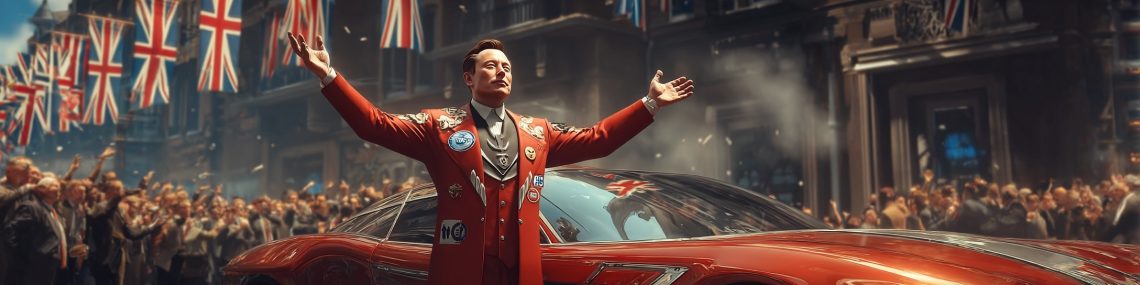
Consider it: Britain’s first African-born (continent of Africa anyway) Prime Minister. Not, as the bien-pensant Left would prefer, a soft-spoken contrition-monger eternally apologising for railways and cricket bats, but Elon Musk: a man who builds rockets for sport, declares war on bureaucracy before breakfast, and thinks nothing of placing mankind upon Mars as if ordering a cab.
In one dazzling stroke, all the moral sermons collapse. The nation so often scolded for its supposed smallness of mind would find itself led by an immigrant from Pretoria, and not merely an immigrant, but the wealthiest innovator alive. The irony would be exquisite. One can practically hear the sound of quinoa spoons clattering onto the parquet floors of Islington kitchens.
And yet the more one rolls this notion around the mind, the more its brilliance shines through. Here is no mere gimmick, but a cunning plan of the most Anglofuturist variety: Albion shaking off her damp tweed of decline, slipping into a new suit of steel and starlight, and placing at her helm a man whose instinct is to accelerate destiny.
The Most Ironic Outcome
It was Musk himself, in one of his more gnomic utterances, who observed that “the most entertaining outcome is the most likely.” A dictum that at first sounds like the sort of thing a wag might scrawl on the back of a pub coaster, but which, the more one ponders it, contains an almost Churchillian punch. For history is rarely neat; it is forever slipping on banana skins, careering round corners, and producing results that cause both mirth and awe.
What, then, could be more deliciously ironic than Britain, a nation so sunk in managerial drizzle that it can barely organise its own train timetables, electing as Prime Minister a man who thinks in orbits? A man who treats bureaucracy as an enemy combatant, laughs in the face of timidity, and wakes each morning asking not “how shall we cope?” but “how shall we conquer?”
It would, in fact, be the perfect Muskian outcome: entertaining, ironic, and in its way almost inevitable. For the truth is that Britain, with its weary chatter of “levelling up” and “net zero strategies,” is primed for precisely such a shock. The soil is parched, the public mood listless, the cultural air heavy with a sense of decline. Into this stagnant pool, one well-placed rocket could electrify the waters.
And here, one senses, is the cunning plan’s deepest genius: Musk as Prime Minister is not merely absurdist theatre. It is the irony that saves. The most entertaining outcome because it would be the most revivifying, a reminder that Britain is not condemned to grey decline and reaching just for Brussels’ approval but for sparkle and the stars themselves.
Younger generations in particular would rally to it. Raised in the meme-forge of the internet, they have grown impatient with soggy managerialism. They cheer the chainsaw-wielding strongmen who slice through red tape abroad, and they would see in Musk a figure cut from that same cloth: a leader who waves the flag not as apology but as promise, who dismantles bureaucracy with relish, and who does it all while pointing them toward Mars.
The Economic and Cultural Shock
It is worth recalling that Musk once toyed with the notion of supporting Nigel Farage, a prospect which briefly thrilled the saloon bars of Britain. Here, thought some, was the alliance to end all alliances: the world’s most mischievous entrepreneur clasping hands with the nation’s greatest pub orator. Yet Musk, ever quick to take a man’s measure, soon discerned the limits. Farage was not a revolutionary but a tinkerer; his stage was the snug of a Kentish pub, not the launch pad of history. He could rattle Brussels, yes, but he would never rewire Britain.
For Musk, the choice was obvious: Albion did not need a grinning raconteur forever threatening to topple the apple cart; she needed a man to hurl a particularly large and unruly cat into the pigeons, scattering the whole cosy aviary of Westminster. Not rhetoric, but ruckus. Not nostalgia, but revolution.
And what a revolution it would be. At its heart would be energy: not the pious rationing of renewables, but a great unleashing of power. Small modular nuclear reactors sprouting along the coasts. Gigawatt battery farms stabilising the grid. Deep-water turbines redesigned by bored SpaceX engineers in their off-hours. Solar networks synced with Starlink, turning Britain into an exporter of abundance. Where once the nation worried about winter fuel bills, now it would fret only about where to store the surplus.
With energy secured, finance could follow suit. Imagine the Bank of England announcing that the pound has been joined, perhaps even replaced, by Dogecoin, “for reasons both strategic and amusing.” London, already the financial heart of Europe, suddenly becoming the crypto-capital of the world. The City, not groaning under the dull weight of Brussels directives, but humming with the bright madness of a Martian economy.
Nor would the shock stop there. Britain’s long-dormant industrial might would be stirred awake. Hyperloops screaming from Manchester to London before most committees had finished their biscuits. Gigafactories rising in Wales. Teesside, once a graveyard of rust, reborn as the Cape Canaveral of the North. In short: a nation that has apologised for existing these past fifty years suddenly standing tall again in craft and creation.
And the culture? That, too, would shift. Instead of the endless sermonising about decline and guilt, the British people would once more find themselves invited to dream. Where Farage had offered only nostalgia, a sepia-toned pint by the fireside, Musk would offer the future: sharp, dazzling, irreverent, and Anglofuturist to its core.
Britannia Resurgent
And so to the matter of national spectacle. For if Britain under Musk is to be reborn, she must not merely tinker with tax codes or shuffle departments. No, she must once again bestride the globe with the élan of a nation convinced of her destiny. And here, Musk’s genius finds its perfect match in Britannia’s long-suppressed instincts.
The Royal Navy, once reduced to floating about in a state of genteel semi-retirement, would suddenly rediscover its purpose. Convoys dispatched to safeguard mineral rights in distant seas. The cry of “Rule, Britannia!” would no longer be nostalgia, but policy. Our frigates would become the arteries of a new industrial age, ensuring the resources of Africa, the Arctic, and beyond flowed into the engines of Albion’s revival.
Meanwhile, from the cliffs of Cornwall and the wide runways of Scotland, rockets would roar heavenward, scattering seagulls and thrilling schoolboys. No more apologetic civil-service memos about “safety assessments” or “European co-ordination.” Instead, an RAF officer with a splendid moustache, clipboard in hand, barking “Clear skies, launch away!” as a Starship punched through the clouds.
Speaking of clouds, even they would no longer be beyond the reach of Muskian mischief. The RAF, equipped with cloud-seeding squadrons, could be dispatched to tidy the weather as neatly as a butler preparing the drawing room. Sunshine for launch days, showers for the crops, drizzle relocated tactfully over France of course.
This, then, is the Muskian promise: a Britain no longer slouched in the grey armchair of managed decline, but marching once more into the world with rockets on her shoulders and salt in her lungs. A Britannia resurgent, proud of her power, unapologetic in her ambition, and marvellously absurd in her methods, which is to say, marvellously British.
The Left in Meltdown
And now, dear reader, picture the scene: the morning after Musk sweeps into Downing Street. Champagne corks ought to be popping in every Islington townhouse, because the hallowed milestone has finally been reached, Britain has elected her first African-born Prime Minister. An immigrant at the pinnacle of power! A man of humanitarian instincts, no less, who speaks endlessly of lifting mankind, saving the environment, and creating a future “for all humanity.” By rights, the Guardian should be in paroxysms of delight.
But alas, they are not. For the immigrant in question is not the type they ordered from the ideological menu. He is not a softly spoken bureaucrat who recites apologies for Empire on cue. He is not a Labour backbencher raised on workshops about intersectionality. He is, instead, Elon Musk: unapologetic, gleefully disruptive, as wealthy as Croesus, and possessed of a habit of tweeting dog memes at three in the morning.
The cognitive dissonance is thunderous. Here is a man who delivers electric cars to the masses, yet they cannot abide that they come stamped with a Tesla badge. He provides mobile internet to remote villages through Starlink, yet they fume because it does not arrive via some approved quango. He speaks of humanitarianism in tones of near-religious zeal, yet his humanitarianism is cosmic, not bureaucratic. And worst of all, here is an African immigrant, precisely the milestone progressives had yearned for, but one who refuses to play the role they scripted.
And if the domestic meltdown were not enough, picture the international reaction. Brussels, which spent years gnashing its teeth over Brexit, would suddenly find Albion not merely departed but strutting about with rockets and Dogecoin. French presidents would hold emergency press conferences in tones usually reserved for invasions. German think-tanks would issue papers entitled “The Danger of Muskism.” At the United Nations, diplomats would splutter as Britain cheerfully vetoed resolutions while announcing a “Martian Accord” with India and Australia. The cognitive dissonance would not stop at the Channel; it would ripple across the globe, leaving a trail of bewildered officials and collapsed lattes.
The contortions would be glorious to watch. Guardian editorials headlined: “Yes, But Not Like This.” Labour MPs issuing statements that collapse into self-parody: “We celebrate diversity in leadership, except when it’s a billionaire who likes rockets.” Students at Oxford gluing themselves to the doors of the Bodleian, protesting not against racism but against the wrong sort of immigrant. And abroad, EU bureaucrats demanding inquiries while secretly wondering if they, too, should invest in Dogecoin.
Meanwhile, the man himself would grin, shrug, and launch another Falcon from Cornwall, while the RAF obligingly shifted the clouds.
And the British public, that wry, sceptical audience so often ignored by its elites, would roar with laughter. For nothing so delights the national spirit as the sight of the moralising classes, at home and abroad, tied in knots of their own contradictions. Musk as Prime Minister would be worth it for the governance alone, but the spectacle of bien-pensants combusting in cognitive dissonance would be a dividend of comic genius.
The Entertaining Payoff
For all the theatre and uproar, one must not forget the cold arithmetic. To capture the British premiership, Musk would scarcely need to rifle through the back cushions of his Tesla sofa. The officially capped spend for a UK-wide election hovers around £35–40 million. Add in deposits and constituency-level campaigning, and you are still within hailing distance of £50 million for a fully legal, fully declared push. A formidable sum for mortals, but for Musk? The sort of money he might spend tinkering with a new seat design in a prototype Roadster.
Contrast this with the United States. To become President, one must assemble a war chest measured in the billions. Biden’s 2020 campaign and Democratic auxiliaries burned through some $1.6 billion. Trump’s machine: a cool $1.1 billion. The 2024 cycle, by some estimates, has hoovered up $14 billion across federal races. By those standards, £50 million would barely buy you a Senate seat, and perhaps not even a particularly glamorous one.
But here in Britain, the arithmetic is very different. For the price of a middling Californian House race, Musk could bankroll an insurgent campaign that topples the entire Westminster order. And this is before we count the uncapped funds of skulduggery. For while the Electoral Commission keeps a beady eye on the official “short campaign” spend, the real art lies elsewhere. One can, for instance, commission lavish “infrastructure” contracts: websites billed at seven figures, “marketing consultancies” paid to “build databases,” or “community engagement officers” who, purely coincidentally, are also your prospective candidates.
None of this technically breaches the rules, yet all of it sluices money into the bloodstream of a campaign. The result? A war machine that looks parsimonious on paper while humming like a well-oiled SpaceX rocket behind the scenes.
Thus the payoff: for perhaps £100–200 million in total outlay, a fraction of what he spends annually just keeping Twitter’s servers from exploding, Musk could seize control of a G7 nation, its nuclear deterrent, its UN Security Council seat, and its centuries of institutional prestige. To frame it in entrepreneurial terms: the return on investment would be the most dazzling in history.
And so, the curtain falls with a suitably British flourish. For what better way to end than with Albion, once again swaggering across the stage of history, rockets at the ready, Navy sails trimmed, and the clouds themselves shifting on command? To the howls of outrage and the wails of contradiction, Musk would grin, puff out his chest, and declare with a cavalier wink:
“Hang onto your tights, Britain! It’s about to get glorious!”
And so, one pauses to reflect: just think how glorious it would be. A Britain no longer the grey accountant of decline, but the swashbuckling impresario of the future. A nation that shrugs off its drizzle, polishes its boots, and decides once again to astonish the world.
Picture the skyline of London pierced not by another half-empty glass tower, but by sky yachts and rockets rising from Cornish cliffs. Imagine the Navy once more cutting purposeful wakes through the oceans, guarding the arteries of commerce. Envision the RAF scattering the clouds to order, while Dogecoin dances on the ticker boards of the City.
Yes, the bien-pensants would howl. Yes, the Guardian would combust daily in exquisite fury. But to the rest of us, to those who believe that civilisation is meant for structure and imagination, not endless apology, the sight would be magnificent. For it would mean that Albion had remembered herself, and remembered that the purpose of a nation is not to manage decline politely but to dare gloriously.
In such a Britain, even the absurd would feel natural, and the ironic would become destiny. Musk at Number Ten might begin as a joke over cocktails, but it would end as the most Anglofuturist flourish of them all: the return of a nation to grandeur by the very act of daring to be absurd.
Just think how glorious.